What is a certificate of incumbency?
A certificate of incumbency identifies the people who hold specified positions in a company at a particular date. Depending on its wording, it may also record shareholders or confirm authorised signatories. Banks can use it when checking who represents a corporate customer, but its usefulness depends on who issued it, what records they checked and what the certificate actually says.
Certificates can carry the same heading yet give a bank very different evidence. One may have a separate notarial attachment explaining whose signature was certified; another may list a shareholding without giving the total issued shares. Another example includes a tailored statement about a company restored to the register. The examples below show what to check before treating the file as complete.
What is a certificate of incumbency used for?
The document helps a third party establish who currently holds office and, where expressly confirmed, who can act for a company. Its uses include opening accounts, arranging borrowing and signing corporate transactions.
In a banking application, read the request closely. The reviewer may need evidence of current directors, direct shareholders, a particular person's signing authority, or several of these things. A document that answers one question may leave another unresolved.
HSBC Malta's published verification guide lists a certificate of incumbency alongside equivalent company-registry extracts. That is an example of one provider's approach, not a rule that every bank must follow. HSBC Malta verification guide
Before ordering anything, ask the receiving bank or EMI:
-
Which facts must the document confirm?
-
Who may issue and sign it?
-
How recent must it be?
-
Will registry documents be accepted instead?
-
Are certification, translation or legalisation required?
For the surrounding application, use the corporate bank account opening documents checklist.
Certificate of incumbency in the UK: what Companies House provides
Companies House does not offer a standard certificate under the name "certificate of incumbency". Its published service provides company certificates with specified certified facts and certified copies of filed documents.
You can request certain additional facts, including directors, the secretary and registered office. A summary statement, formerly called a good standing statement, concerns the company's continued existence and the absence of current strike-off action. Companies House expressly excludes information about persons with significant control (PSCs), shareholders, shareholdings and statements of capital from these certificates. Companies House guidance
A bank may ask for one document covering management, ownership and authority. An official certificate containing directors' names will not necessarily answer all three questions. For ownership, work from the relevant shareholder records and reconcile them with the ownership structure chart.
For a UK company-issued certificate, agree the format and acceptable signatory with the recipient. Have the person preparing it identify the records behind each statement.
Ireland and Cyprus: check the document behind the label
A cross-border request can use terminology that differs from the company's home registry. Start with the facts required, then identify the documents that support them.
Sources: Irish CRO and Cyprus Registrar's certificate application.
These documents establish different facts. Ask the bank to confirm the proposed combination before ordering it.
Incumbency, incorporation, good standing and a board resolution
These documents answer different questions.
A certificate of incorporation records the company's formation. It does not tell you which directors remain in office today.
A certificate of good standing or status addresses matters defined by the issuing registry. Check its wording; do not assume it verifies every shareholder or authorises a banking transaction.
A certificate of incumbency records current officeholders and any other facts expressly included.
A board resolution or bank mandate addresses the relevant decision or signing arrangement. Being named as a director is not, by itself, a complete description of the account's signing rules.
HSBC's published account-opening samples illustrate the distinction by providing separate documents for incumbency, a board resolution and a mandate. Those samples are useful illustrations, not universal forms for UK or EU applications. HSBC document samples
In practice, compare the people named in the authority documents with the corporate records, then check that the application follows the stated signing arrangement.
Certificate of incumbency format: a preparation template
There is no single format that will satisfy every issuer and recipient. Use the outline below to brief the company secretary, registered agent or adviser preparing the document. It is a preparation aid, not an issued certificate.
Company: [full legal name, registration number and jurisdiction]
Relevant date: [date the stated facts are confirmed as at]
Issuer: [name, role or professional capacity, and contact details]
Records examined: [specific records and their dates]
Current officeholders: [full names, positions and any appointment details requested]
Additional facts requested: [for example, direct shareholders; include only what the issuer can substantiate]
Signing authority, if covered: [scope of authority and the supporting resolution or mandate]
Attachments: [documents supporting the statements]
Execution: [signature, date and any certification required by the recipient]
Avoid adding broad statements about solvency, litigation or beneficial ownership simply because they appear in a downloaded certificate of incumbency template. Each extra statement needs an appropriate evidential basis and someone entitled to make it.
The same discipline applies to signatures. Establish who is signing the certificate and in what capacity. If the certificate names that person as an authorised signatory, check how the underlying authority is evidenced as well.
A document-check table for the onboarding file
Use this before submission. The right-hand column gives examples of issues to resolve, not automatic reasons for a bank to reject an application.
- Current appointment and resignation records
- registry information
- The mandate requires two signatures
- the application assumes one.
Record an action owner for each unresolved item. A useful note is specific: "Secretary to confirm the director change and obtain a corrected certificate." "Check documents" leaves the next person to repeat the investigation.
Where ownership is layered, a certificate listing a corporate shareholder does not, on its own, explain the entire chain to the ultimate beneficial owners.
Four certificate of incumbency examples from different jurisdictions
These examples describe four historical document sets. Identifying details have been removed. They illustrate the wording and attachments in those particular files, not standard requirements for every company in each jurisdiction. The scans have not been independently authenticated.
For a UK or EU onboarding adviser reviewing a foreign company's documents, the task is to separate the corporate statements from the authentication attached to them.
- A corporate company secretary
- the statement lists the director, the secretary and the shareholder.
- A registered agent
- the statement covers legal standing, authorised capital, a director, an officer and a shareholder.
- Separate the capital figures from the shareholder's holding
- check the issuer's capacity.
- A registered agent
- the statement includes legal standing, capital, a director, a principal shareholder and renewal information.
- A certified-true-copy stamp appears on the certificate
- no apostille is included in the one-page scan.
- A registered agent
- the statement lists corporate facts and expressly addresses restoration after striking off.
- Check the restoration evidence and legal basis behind the continuity wording
- the apostille does not verify that conclusion.
Signature verification in the Hong Kong example
The Hong Kong set contains three pages with three different jobs. The company secretary makes the corporate statements. A notary then identifies the signature on that certificate by comparing it with a specimen held in the notary's records. The apostille identifies the notary and the notary's capacity. The certificate's footer limits its scope to the information requested and the records held at the registered office. That qualification belongs in the review notes alongside the names and dates.
The signature being compared is the signature of a person acting for the corporate secretary. It is not presented as a specimen signature for the subject company's bank account. The certificate's execution block therefore should not be copied into a bank mandate as evidence of an account signatory's authority.
For context, the Hong Kong Judiciary lists documents signed by notaries among those accepted for its apostille service. That does not make this particular scan authenticated or establish that every incumbency certificate needs the same route. Hong Kong Judiciary apostille service
When reviewing a similar pack, follow each reference to the annexed document and compare the company details, dates and signing capacities across the pages. Sending only the page with the most impressive seal may leave out the statement the bank actually needs.
Share capital in the Marshall Islands example
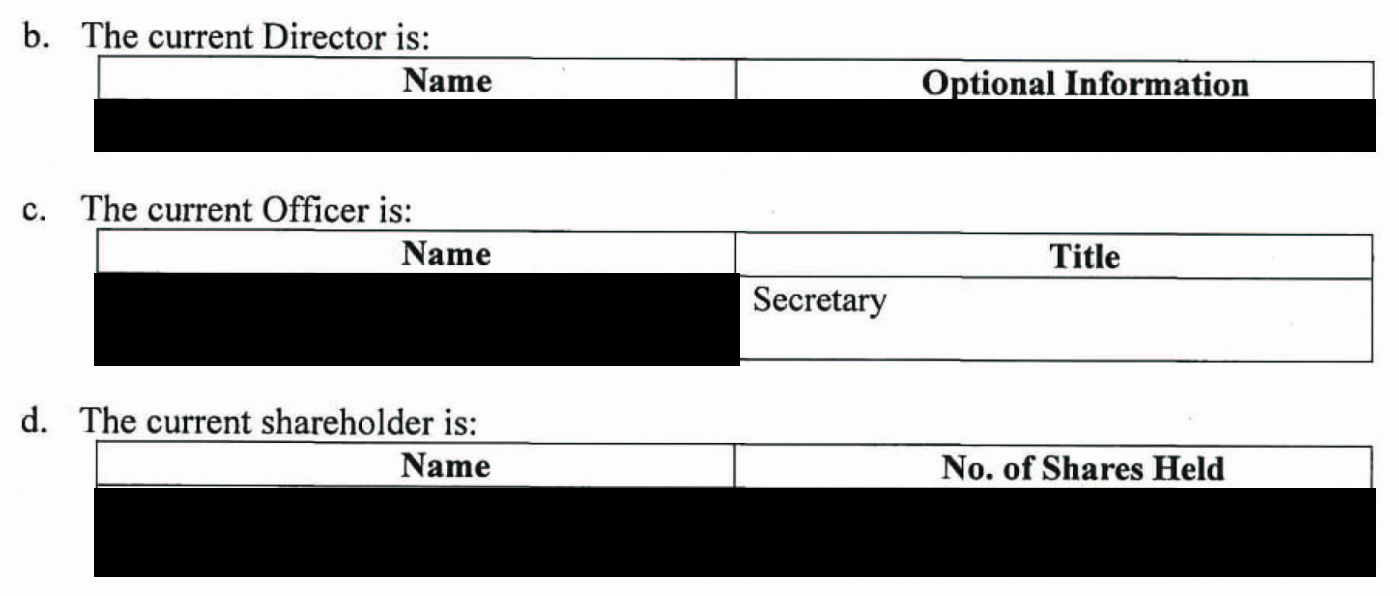
The registered-agent certificate separates the current director, officer and shareholder into different tables. One person can appear in several roles; the entries should still be checked separately. An officer's title does not supply the account's signing rules.
 Open full size
It also states an authorised capital figure and a number of shares held by the named shareholder. The certificate does not expressly give a total issued-share count. Dividing the holding by the authorised maximum would not establish the holder's ownership percentage.
Take a separate hypothetical calculation: a company has 50,000 authorised shares and a listed holder has 200 shares. Calculating 200 divided by 50,000 gives 0.4%, but that is not proof of a 0.4% stake. Establish the issued shares in the relevant class and the rights attached to them using the supporting ownership records.
The apostille adds another reading lesson. Its country field names the Marshall Islands, while the place of certification is Zurich. Record the company jurisdiction, place of certification and issuing capacity separately. The city on the authentication page is not the company's place of incorporation; validity still needs to be checked through the appropriate verification route.
Copy certification in the Saint Lucia example
The Saint Lucia certificate brings several statements onto one page: legal standing, authorised capital, a director's appointment, a principal shareholder's ownership and voting rights, and a future annual-renewal date. A later certified-true-copy stamp is also visible.
Those dates answer different questions. The certificate date identifies when the corporate statement was made. The copy stamp records the copy-certification date. The renewal date is a future event stated in that historical certificate, not evidence that the renewal was subsequently completed.
This matters if the file is reused for a later application. Ask for up-to-date corporate information and any evidence needed for renewal or standing; a recent copy of an older statement cannot establish those later facts. The one-page scan contains no apostille, which describes the supplied file rather than proving that no other authenticated version exists.
Restoration wording in the Saint Vincent example
The fourth certificate goes beyond listing directors and shareholders. The registered agent confirms that the company was restored to the register with Active status after being struck off. It then states that the company is "deemed to have continued in existence" as an active entity as if it had never been struck off. That is the agent's stated position in this particular document, rather than a general rule established by this article.
 Open full size
Read the document excerpt
Original wording from the certificate
Following its temporary striking-off from the Register of Business Companies of Saint Vincent and the Grenadines, the Company was subsequently restored to the Register with 'Active' status, and pursuant to the laws of Saint Vincent and the Grenadines, it is deemed to have continued in existence as an active entity as if it had never been struck off.
The distinction is useful: a statement that a company is active today answers a different question from a statement about the effect of restoration on its earlier existence. The certificate contains both. It does not give the strike-off and restoration dates or cite a statutory section. For another file, ask for the restoration record and the current legal provision supporting the proposed wording.
The second page is an apostille identifying the signer in the capacity of registered agent. As with the other examples, that authentication does not verify the underlying corporate statements or their legal interpretation.
Across all four formats, record the issuer's role, the records behind the statements, the relevant dates and the exact purpose of each authentication. Keep signing authority as a separate check unless the document expressly addresses it with adequate supporting evidence.
Can a certificate of incumbency replace a legal opinion?
It can sometimes answer the particular question behind a bank's request, if the bank agrees to accept it. The Saint Vincent case shows how that can work.
In this case from our onboarding work, a bank requested a legal opinion concerning a company that had been struck off and subsequently restored. Obtaining the opinion was expected to cost more than US$5,000.
The corporate agent included the paragraph about restoration and continuity of existence described above in the certificate of incumbency. The bank accepted the certificate for that particular request, and the certificate cost substantially less than the proposed opinion. In our experience, discussing the scope of a confirmation with an existing corporate agent is often simpler than commissioning a separate opinion from independent counsel.
The wording addressed the point the bank needed clarified. It did not change the company's history or create a different legal position. The bank's acceptance and the cost comparison are our account of the case; neither is evidenced by the certificate itself. This outcome does not establish a policy for other banks or other legal questions.
For a similar request:
-
Identify the precise issue: current status, restoration, legal continuity or the validity of a particular transaction.
-
Ask the bank whether a supported agent confirmation would satisfy that issue before commissioning an alternative to the requested opinion.
-
Ask the agent what it can properly confirm, from which records and under which current legal provision. Request supporting restoration evidence where relevant.
-
Keep the bank's acceptance with the submitted version so that another reviewer can see what was accepted and for which purpose.
A useful question for the bank is: "Would you accept a registered-agent certificate confirming restoration and explaining its effect on the company's legal existence, supported by the restoration record and relevant law?"
If the bank still requires an opinion from independent counsel, follow that requirement. A continuity statement alone does not establish the validity of every transaction during the struck-off period, continuous trading, or compliance with every regulatory obligation. Those are separate questions for the appropriate evidence and legal analysis.
How recent must the certificate be?
Ask the bank for its recency requirement. Do not assume a universal three-month or six-month validity period.
There are two dates worth checking: when the certificate was issued and when the facts it confirms were established. A recent true-copy stamp does not, by itself, update the underlying company facts. A corporate change after issue may also make a certificate unsuitable even while it falls within the bank's age limit.
If documents were collected over several weeks, check for changes again just before sending the pack.
Does a certificate of incumbency need an apostille?
It depends on where the document is issued, where it will be used and what the recipient requires. Certification, notarisation and an apostille are separate questions.
For UK documents, the FCDO advises checking whether the recipient needs an original or certified copy and whether a particular professional must sign it. Some documents need certification by a UK public official, such as a solicitor or notary, before legalisation. FCDO legalisation guidance
An apostille authenticates the document's origin, including the relevant signature, capacity and seal where applicable. It does not certify that every statement in the underlying document is true. HCCH Apostille Handbook
Resolve content errors before arranging the formalities. Paying to legalise a certificate with an outdated director list will not repair that list.
How to obtain the right certificate without ordering twice
Send the bank's request to the person responsible for the company's corporate records. Include the applicant's jurisdiction, the facts requested and the bank's rules on issuer, recency and certification.
Ask for a draft or a description of the proposed document before authorising paid preparation. For a registry alternative, obtain confirmation from the recipient that the proposed records will meet its request.
Review the names, dates, authority and attachments using the table above. Arrange any agreed certification, legalisation and translation once the content is settled. Then check the completed document against the application again.
If the bank asks for clarification afterwards, answer the particular question and point to the relevant evidence. Our guide to additional information requests explains how to organise that response.
Frequently asked questions
Who issues a certificate of incumbency?
The route depends on the jurisdiction and document requested. A company secretary or other authorised officer may prepare a company-issued version; a registered agent or professional adviser may provide or certify a document within their remit. Confirm the acceptable issuer with the receiving institution before commissioning it.
Can I prepare my own certificate of incumbency?
You can assemble the facts and supporting records, but that does not mean the recipient will accept a self-prepared certificate. Agree the issuer and signing requirements first. Use a template to organise verified information; do not treat it as proof of its own contents.
How much does a certificate of incumbency cost?
There is no single price across jurisdictions and issuers. Ask for a quote separating document preparation, registry documents, certification or notarisation, apostille, translation and delivery. Check which items the recipient actually requires before paying for them.
How long does it take to get one?
Ask for a delivery estimate that includes record checks, any corrections, signatures and the formalities your bank requires. A quote for preparing the certificate may exclude notarisation, an apostille or courier time. Work backwards from the submission deadline and confirm each stage with the provider.
Does it replace beneficial ownership checks?
No. Even where shareholders or beneficial owners are mentioned, read what the issuer has verified. The receiving institution may need additional records to establish ownership and control. A director, a shareholder and an authorised account signatory can be different people.
Prepare the whole case around the evidence
Before uploading the certificate, read it alongside the application, ownership chart and authority documents. Check that the same entity, people, dates and signing rules appear where they should.
About the author
Alexander Blinov is the founder of OnboardOS. His experience spans corporate legal services, KYC/AML and onboarding international companies with banks and EMIs. He is developing OnboardOS to help corporate service providers gather client information, identify evidence gaps and prepare coherent account-opening submissions.
Explore OnboardOS, designed to organise client information, corporate documents, compliance gaps and submission preparation within a structured corporate onboarding workflow.
OnboardOS helps corporate service providers organise client information, supporting documents and outstanding onboarding gaps in one case.
Sources and further reading
These references cover different jurisdictions and document functions. HSBC materials illustrate the named providers' practices. Requirements depend on the receiving institution and applicable jurisdiction.
-
HSBC Malta - Identification and Verification (ID&V) Certification (PDF) Provider-specific example.
-
Companies Registration Office, Ireland - Frequently asked questions
-
Cyprus Registrar of Companies - Application for Issue of Certified Copies of Companies (PDF)
-
HSBC Hong Kong - Document Samples for Business Account Opening (PDF) Provider-specific example.
-
HCCH - Practical Handbook on the Operation of the Apostille Convention (2023 edition, PDF)
Related resources

Corporate Bank Account Opening Documents: The Complete Checklist
Read article
Ownership Structure Chart for Bank and EMI Onboarding: What to Include and How to Document It
Read article